
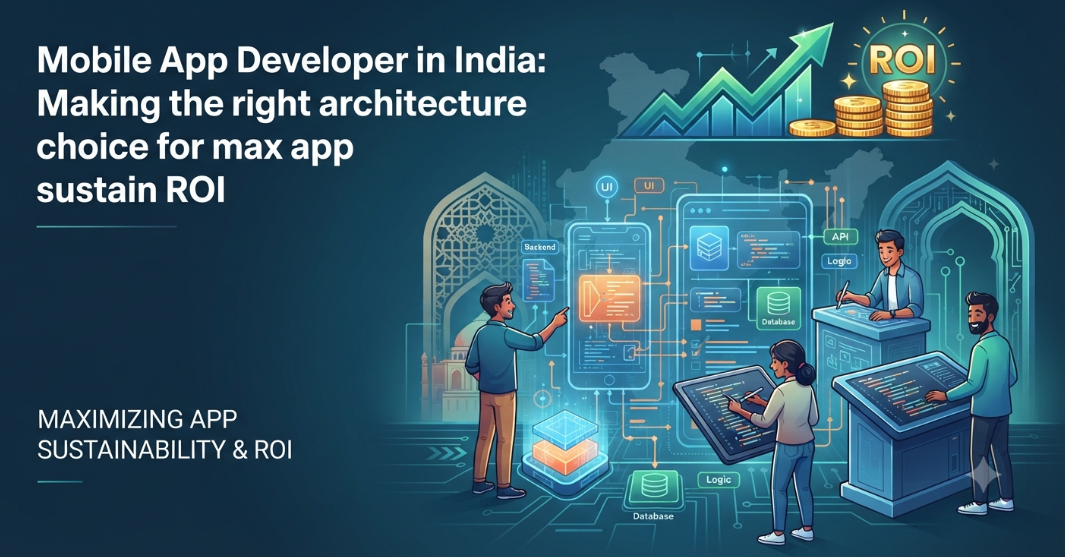
Building a profitable and scalable app relies heavily on making the right structural and architectural decisions from the very beginning. Mobile app development teams in India, such as Obalesh Solution, help founders maximize ROI by balancing technical quality with cost-effectiveness through tailored framework choices, scalable backends, and performance-focused designs. Ultimately, a well-architected app directly improves load times, stability, and App Store Optimization (ASO) rankings, ensuring long-term user retention and business growth.
Mobile app developer in India: Making the right architecture choice for max app sustain ROI
Building an app that ranks correctly, retains users, and makes money isn’t always a pretty feasible idea; it’s about the architecture behind that idea. This is why so many founders and agencies are now turning to mobile app developers in India – they combine technical intensity with cost-effectiveness, and companies like Obalesh Solution have made this mix their core strength.
If you are making plans for your next app and want it to deliver real app-saving ROI, the structural decision you make at the beginning will determine whether your app scales smoothly or collapses under the weight later. Let’s break down what this means and how mobile application developers in India, especially teams like Obalesh Solution, approach it.
Why Architecture Decides Your App’s Future
Many founders assume architecture is a “backend problem” that can be fixed later. In reality, the architecture you choose affects app tempo, cost of failure, replacement frequency, or even how your app is treated by app keep algorithms. A poorly architected app ends up with sluggish load cases, frequent bugs, and bad criticism – all of which quietly kills your ROI. This is exactly why mobile app developers spend vast amounts of time inside the planning phase before writing a single line of code. Obalesh Solution, for example, maintains a discovery component where business goals, forecasted user load, and revenue plans are mapped to an appropriate technical structure.
Native, move-platform, or hybrid: the first huge decision
One of the most common questions that customers in India ask cellular app developers, one of the first things top mobile application development in India make prematurely clear is whether or not to shift local (separate codebase for iOS and Android), cross-platform (Flutter or React Native), or hybrid.
- Native apps offer quality performance and the right to access private device functions. They’re best for apps that rely closely on cameras, sensors, or complex animations.
- Building cross-platform apps is faster and less expensive, considering that one codebase makes each system a server. This is often the sweet spot for startups watching their budget.
- Hybrid apps sit in between and are useful for content-driven apps that don’t need a lot of device integration.
Obalesh Solutions generally recommends cross-platform frameworks for MVPs and early-stage products, then transitions to native modules as the app scales and detailed overall performance bottlenecks emerge. This step-by-step approach is a hallmark of experienced mobile app developers in India, who understand that ROI is a long sport, no longer a one-time release event.
Scalability: Designing for Increment, Now Not Just Launch Day
App shop ROI no longer comes from downloads alone. That comes from retention, in-app purchases, subscriptions, and ad sales that grew over the years. With that approach, your form should support scaling customers, scaling information, and scaling functions without a whole rebuild. Mobile app development in India working on serious commercial products built with microservices, cloud-native backends, and modularized front-end components from day one. Obalesh Solution follows this one-size-fits-all philosophy, structuring apps so that new features, new markets, or sudden user spikes now don’t require overhauling the overall product. This matters more than most founders realize. A viral marketing campaign that doubles your downloads overnight is a great problem to have—unless your architecture can’t handle the load, in which case it becomes a five-star-review-turned-one-star-review disaster.
Backend and API Strategy
A big part of what separates average mobile app develop from top-tier ones is how they design the backend and API layer. RESTful APIs, GraphQL, and serverless functions each have trade-offs in speed, cost, and flexibility, and skilled mobile app developers weigh these trade-offs against the specific app’s needs before committing to one. Obalesh Solution typically recommends GraphQL for apps with complex, nested directories (like marketplaces or social apps) and lightweight REST APIs for simpler, transactional apps. Choosing correctly right here without delay affects app speed, which in turn affects app store rating – taking into account every Google Play and Apple App Store element of performance metrics like load time and crash-free period while determining visibility.
Cost-effectiveness without compromising quality
One reason global businesses prefer mobile app developers is the balance of quality and cost. Building a scalable, well-architected app in India typically costs a fraction of what it would in the US or Western Europe, without sacrificing engineering standards—a reputation that has made mobile app development in India a go-to choice for founders across the US, UK, and Australia.
Obalesh Solution has built a reputation around this exact balance—delivering enterprise-grade architecture at a price point that lets startups reinvest saved budget into marketing, ASO (app store optimization), and user acquisition. This combination of technical rigor and financial sense is what genuinely maximizes ROI, rather than just cutting corners to save money.
App Store Optimization Starts with Architecture
It’s easy to assume that ASO is most effective around keywords, screenshots, and outlines. But app save algorithms also weigh technical signals: crash rates, load speeds, switch consistency, and user engagement styles. All of this suggests lower back to architecture inside the technology roadmap instead of treating it as an afterthought.
Mobile app builders in India who realize this connectivity configuration apps that can inherently be ASO-friendly - fast, solid, and smooth to replace. Obalesh Solution builds this thinking into every campaign, treating architecture and app shop overall performance as facets of the same coin as opposed to separate gigs handled by different teams.
Choosing the right partner
With so many mobile app developers in India competing for business, the real differentiator is not just technical skill but judgement – knowing when to choose native over cross-platform, when to scale infrastructure, and when to hold back and keep things lean. Obalesh Solution has positioned itself around this judgement, working closely with clients to match architecture decisions to actual business goals rather than trends.
Final thoughts
Maximum app store ROI isn’t an accident. It’s the result of deliberate architecture choices made early, backed by teams who understand both the technical and business sides of app development. Whether you’re building your first MVP or scaling a current app, it can be the difference between an app that just exists and an app that’s clearly growing and making money. If you’re evaluating your next mobile assignment, make an effort to discuss architecture alternatives with your partner. It’s the only choice you have to make before writing a line of code.